Traffic and Parking on Main Street: The Problem Nobody Designed
Main Street carries two-way traffic on a road too narrow for it. The village was never designed for this volume of cars. Here is the problem.
Bottom line
Article summary
Main Street carries two-way traffic on a road too narrow for it. The village was never designed for this volume of cars. Here is the problem.
Stand outside Fabio’s on Main Street, Coolock Village, at 5pm on any weekday. Watch what happens.
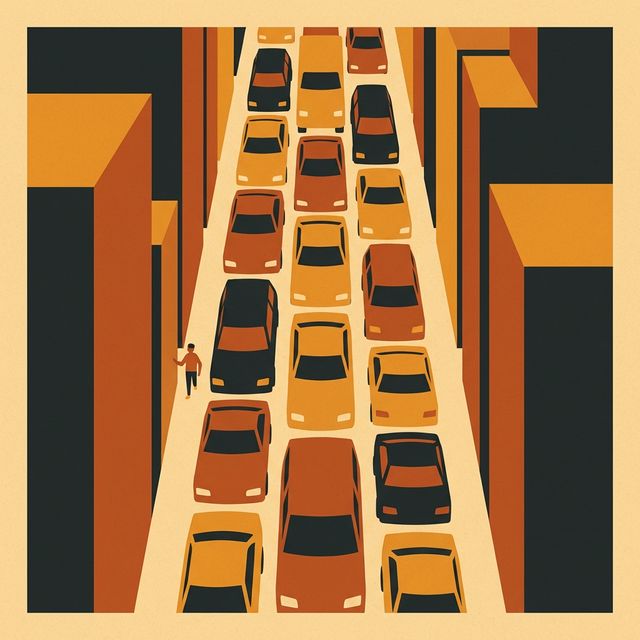
A Dublin Bus heading south towards the city meets a truck heading north towards Malahide Road. The road is too narrow for both. One has to slow, half-mount the kerb, or wait while the other squeezes past. Meanwhile, a driver behind the bus gets impatient, swings out to overtake, and realises there is oncoming traffic. Brakes. Horns. A pedestrian on the narrow footpath flinches.
This happens every day. It is not an unusual event. It is the normal operating condition of Coolock Village’s main street.
A traffic corridor, not a village
Main Street (part of the R107, Malahide Road) is classified as a regional road. It carries through-traffic between Dublin city centre and the northern suburbs. It was never intended to be a place where people stop, shop, or sit — and it shows.
The road is two-way, with no protected crossing at the busiest sections. Footpath quality varies: in some places, pedestrians walk within arm’s reach of passing buses. There is no bench seating. There is no street furniture that invites you to stay. The street reads as a traffic corridor that happens to have shops on it, not a village centre.
The parking problem
Parking on and around Main Street is a daily source of friction. There are not enough spaces for the 36 businesses listed in the village directory, their customers, and the residents of nearby streets who rely on on-street parking overnight.
Double-parking is common. Cars park on footpaths. Delivery vehicles block sightlines at junctions. The side streets — Greencastle Road, Casino Road, Brookville Park — fill up early in the evening and stay full until morning.
Dublin’s traffic policy: punishing drivers without providing alternatives
Dublin was ranked the third most congested city globally in early 2026. The Dublin City Centre Transport Plan 2023 aims to reduce general traffic in the core by 40%. The logic is sound: reduce private car use in the centre, free up space for buses, cyclists, and pedestrians.
But the plan has a hole in it. It assumes people have alternatives. For many Coolock Village residents, they do not.
Bus service reliability
Coolock Village is served primarily by Dublin Bus routes including the 27 and 27a. Based on user-reported data, the 27 has an on-time performance of 71%. The 27a sits at 61%. Roughly one in three buses is late or does not show up. For a resident who works in the city centre, this means you cannot reliably depend on the bus. So you drive.
BusConnects uncertainty
BusConnects promises improved frequency, but it has generated concern. Routes 27 and 27a were rumoured for cancellation in future phases. As of early 2026, both are still running, but residents cannot plan around a service they aren’t sure will exist. Areas like Coolock Village depend entirely on buses—there is no Luas or DART fallback.
No rail, no tram, no metro
It is worth stating plainly: Coolock Village has no rail connection. The DART does not reach here. The Luas does not reach here. MetroLink, when built, will terminate at Swords—north of Coolock Village, not through the village. The nearest DART is Harmonstown, over 2km away. Unviable in the rain or with heavy shopping.
Speed limits and safety
New national speed limits came into force in February 2025, reducing local roads to 60 km/h. Dublin City Council is assessing roads for a reduction to 30 km/h by 2027.
Lower speed limits are welcome on paper. But on Main Street, the problem is not the posted limit — it is the road design. A two-way road with tight clearances and pedestrians within arm’s reach creates conditions where even 30 km/h feels dangerous. The width of the road invites higher speeds. Drivers accelerate between pinch points. No sign will fix a road geometrically wrong for two-way traffic.
What a Section 38 trial could do
Under Section 38 of the Road Traffic Act, Dublin City Council can implement traffic calming measures — including one-way systems — as a trial for up to 18 months without prior public consultation. The trial itself serves as the consultation.
This is the mechanism behind the Traffic and Parking Reset proposal on this site: convert Main Street to one-way northbound, introduce angled parking, add raised crossings, and designate side streets for bikes.
A one-way system on Main Street would:
- Remove the oncoming-traffic conflict that makes the street feel dangerous
- Create space for angled parking, increasing total spaces
- Widen the effective footpath so pedestrians aren’t dodging wing mirrors
- Slow traffic naturally by changing geometry, not just signage
The cost of doing nothing
Every year without intervention, the pattern reinforces itself. Traffic volumes stay high because the road is designed to carry through-traffic. Pedestrians avoid the street because it is unpleasant. Footfall stays low. Businesses close.
What Residents Can Do
- Read the proposal. Review the Traffic and Parking Reset page on this site for the detailed one-way plan.
- Email your Councillors. Ask them to support a Section 38 trial for Main Street Coolock Village.
- Spread the word. Talk to neighbors. The more people asking for geometric change, the harder it is for the Area Office to ignore.
If you live or work here, you already know what the problem feels like. The question is whether anyone with the authority to act will treat it as a priority.
Coolock Village Regeneration Project
Community Initiative
Keep reading